Tuesday, September 28, 2010

Interstate Wildlife Violator Compact

The following comes from The Outdoor Wire.

I feel it is time Vermont and other states that are not part of this compact get onboard. There is no excuse for not presenting a united front against poaching. Suspensions of the right to hunt and fish has always been our best deterent to those tempted to violate. But with neighboring states close by our repeat violators have no problem "legaly" hunting will waiting out their Vermont suspensions. We could also easily become a destination state for out of state violators as more states clamp down an sigh the compact.


Pennsylvania Game Commission Executive Director Carl G. Roe praised Gov. Edward G. Rendell for signing Senate Bill 1200 into law, which clears the way for Pennsylvania to join the Interstate Wildlife Violator Compact (IWVC). 
 
"We are one step closer to banding with 37 other states in a united front against convicted poachers, who steal from all citizens, most especially, law-abiding hunters," Roe said. "Once we complete the administrative step to join the compact, someone who has lost his or her hunting license privileges in one state for a poaching conviction will lose those hunting license privileges in Pennsylvania, as well as in all states that are members of the compact.

"In addition, individuals convicted of poaching here in Pennsylvania will lose their ability to lawfully hunt in the 37 other states who are members of the IWVC."| For More...

Sunday, September 26, 2010

Nelson's Deer Management Plan as submitted to the Ag Dept on Sept 10th. Some very interesting stuff in it. I'd be interested in what you think...

Nelson Farm Mgmt Plan                                                            

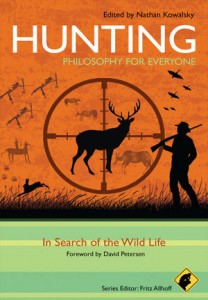
HUNTING: In Search of the Wild Life

The following comes from the Mindful Carnivore Blog. I haven't gotten the book yet, but the chapter by former Orion board member Val Geist is very well done.

Hunting philosophy for (and by) almost everyone

A philosopher I am not.
Not in the academic sense, at least. My formal education in the subject consists of a single undergraduate class—“Reason and Argument”—which left me impressed by the contortions through which the human animal is willing to put its gray matter.
So, some fifteen months ago, when I saw a “call for abstracts” for a new anthology of philosophical essays on hunting, I had reason to doubt my suitability as a contributor. The editor welcomed abstracts from philosophy, of course, and also from a number of other disciplines—such as anthropology, political theory, and theology—in which I was equally unqualified.
Yet there was this one little phrase. They also welcomed abstracts from “thoughtful hunters.”
After a few helpful email exchanges with the editor, Nathan Kowalsky of the University of Alberta, I said, “What the heck. Why not?” and shot from the hip, firing off a 250-word description of the 4,500-word essay I would write if he and his colleagues wanted me to.
A month later, I got word that they did.
Hello. Time to step up to the plate and deliver “Hunting Like a Vegetarian: Same Ethics, Different Flavors.”
Jump a year ahead and here we are: the book, Hunting: In Search of the Wild Life, has just been released, as part of Wiley-Blackwell’s series Philosophy for Everyone.
Read More

Wednesday, September 22, 2010

Who Owns North America’s Wildlife?

The following article was put together by an Orion board member:

The answer to “who owns wildlife?” differs greatly in the United States and Canada from the rest of the world. In North America wildlife does not belong to individuals. Instead it belongs to everyone with federal, state and provincial governments responsible for managing wildlife on public land. However, this bedrock principle is being tested in Vermont now.

In the final days of Vermont’s 2010 legislative session, language known as the Nelson amendment was inserted in the appropriations bill (H.789 Sec E.702.1), which changed the status of native deer and moose enclosed on a captive shooting facility from the public domain to private ownership.

This legislation was reportedly passed to save a celebrity game preserve moose known as Pete from being culled. Rules governing captive-hunting facilities were adopted by Vermont’s Fish and Wildlife Board, and stipulated game preserves could not have any moose or white-tailed deer in their enclosures as way to protect wild herds from chronic wasting disease, tuberculosis and other diseases carried by captive animals.

The Nelson Amendment of H.789 contains language that transfers regulatory authority of illegally taken native deer and moose from the Vermont Fish and Wildlife Department to the Vermont Department of Agriculture and permits an individual citizen to own and profit from those wild animals that rightfully belong to all Vermont citizens.

Several groups are up in arms over this threat to public ownership of wildlife including Orion-The Hunters’ Institute, a nonprofit organization dedicated to upholding hunting by providing intellectual leadership on hunting-related issues.

 “This giveaway of public wildlife resources to a single individual for personal gain threatens wildlife management in Vermont and beyond,” said Eric Nuse, executive director of Orion - The Hunters' Institute. “To change this management system, just to solve a short-term problem without any debate or input from the public and the professionals at the Fish and Wildlife Department, is reckless governance.”

The concept of ownership by the people and management by federal, state and provincial governments is known as the public trust doctrine of wildlife. It’s one of the reasons why this country enjoys the greatest diversity, quality, and quantity of game animals and other wildlife in the world. The idea dates back to when America defeated the English during the Revolutionary War. When wildlife was transferred from the King to the new government and thus to the people, it nullified the centuries-old European model where wildlife was privately owned and hunting was reserved for the upper class.  Since then, a series of Supreme Court rulings have firmly established the public trust as it relates to this country’s wildlife.

For more information about Vermont’s public trust doctrine issues, click here (link externally to  http://fairchasehunting.blogspot.com/)

Clearinghouse Information Available on Hunting Access, Landowner Relations and Wildlife Stewardship on Private Lands


image of private lands with hunting accessNatural resource managers can now access a comprehensive clearing-house of information resources crucial to improving hunter access, landowner relations, and wildlife stewardship on private lands, reports the Wildlife Management Institute. Combining years of exhaustive research with the expertise of numerous partnering organizations, the North American Hunting Heritage Action Plan (HHAP) Website (www.huntingheritage.org) now offers a comprehensive compendium of legal information and documentation to assist administrators protect and enhance North America’s hunting heritage.
With data and research pooled from the Association of Fish and Wildlife Agencies, Wildlife Management Institute, and Vermont Law School Land Use Institute, the online database is organized and cross-referenced according to state and/or information type. Users can view any state recreation trespass law while also examining past court cases that have challenged it.  In addition, users can peruse summaries of financial incentives each state provides landowners who agree to preserve undeveloped areas or allow public and hunting access. 
“This new web-tool will benefit many different audiences,” observed Katherine Garvey, Land Use Fellow at the Vermont Law School Land Use Institute.  “For example, landowners can find their state online to see if they are eligible for certain tax incentives for allowing recreation access to their property.  The natural resource management community can compare the conservation and recreation access-related incentives of state programs.  And state policy makers and conservation administrators can gain insights into how to protect landowners from lawsuits stemming from hunter access.”
Increasingly, legal barriers and fear of litigation have stalled or prohibited private landowners from permitting hunters to enter their property. According to numerous studies examining factors leading to dissatisfaction among active hunters, restricted access to hunting lands has consistently ranked near the top of the list. Until now, there has been very little information available to policy makers and wildlife managers on how to increase hunter access while providing legal protection to landowners.  Fortunately, the resources now available on the HHAP Website include not only a list of the ten recreation statutes most favorable to landowner protection, but also model statute language designed to shield landowners from liability for injuries sustained by recreational land users.
The new web-tool offers managers resources to explore ways that financial incentives have been and can be used to encourage landowners and land-holding corporations to participate in recreational and hunting access programs.  “Tax incentives are among the most significant motivators for conservation of natural resources on private lands,” stated Garvey. “The Land Use Institute research available on the HHAP website is the first detailed compilation of state tax incentives of all 50 states related to conservation and public access.” Similarly, the compendiums of state recreation use/recreation trespass laws and their case histories provided by the Association of Fish and Wildlife Agencies are exclusive to the new HHAP legal content.
To view the new HHAP website additions, please follow the links under the “Legal” tab located at the bottom left corner of the Home page

Friday, September 10, 2010

Nelson Shooting Facility Plan Due Today

Despite the headline below, this is not about Pete. This issue as regular readers of this blog know, is about keeping wildlife wild. Nearly all wildlife groups in Vermont agree the Nelson amendment needs to be repealed. This would force Nelson to negotiate with the FWD on removing all wild deer and moose from his fenced in shooting grounds and to comply with the FW Board regulations on shooting his red deer.
The odds of the plan due today being anything but a blueprint for Nelson selling "hunts" for Pete and the rest of the formerly wild life is about nil.

From WCAX TV news website: 

Irasburg, Vermont - September 10, 2010
Another page today in the drama of Pete the moose.
The animal is living on an elk hunting preserve in Irasburg after he was mauled by dogs, but the Fish and Wildlife Department planned to kill Pete. It's illegal to hold wild animals in captivity out of fear they'll spread disease.
Today is the deadline for the land owner to submit a plan to the state on turning his wildlife preserve into a wildlife farm.
WCAX News

This is my comment left on the website:
Eric Nuse
It is true the FWD is very concerned about the spread of disease, thus Pete could not be released in the wild and no other facilities would take Pete. However, the larger principle is wildlife is owned by all and held in trust by the State. Therefore wildlife can not be owned or held captive by any one person. Thus Pete was illegally taken and held by Mr. Nelson along with the other fenced moose and whitetail deer on his canned hunt facility. It is in the interest of everyone to keep wildlife wild.

Thursday, September 2, 2010

Elk hunt-park owner fined

Now the question is will he meet the Sept 10th deadline and will he comply with all the other deadlines outlined in the law. Not to mention complying with existing Ag rules for elk farms.


Wednesday, September 1, 2010
Richard Nelson fills a feeding trough at Big Rack Ridge in Irasburg as an elk approaches to feed  June 14. Nelson and his father, Doug, keep a herd of 50 or more bull elks at the hunt park, where clients pay hefty sums for a guaranteed kill.

Elk hunt-park owner fined

Doug Nelson, operator of the Big Rack Ridge elk-hunting park in Irasburg, was fined $4,250 Wednesday for failing to comply with provisions of a law he himself had sought. More - 4:56 pm (14)


Read more: http://www.burlingtonfreepress.com/local/#ixzz0yN4Yo1Mf
 

Tuesday, August 31, 2010

Pat Hudak Joins Orion Board

 Orion Welcomes Pat Hudak to the Board

JOHNSON, Vt. - Eric Nuse, executive director of Orion - The Hunter's Institute, announced the nonprofit organization's newest board member, Pat Hudak.

"With Pat's expertise in hunting issues and outdoor marketing, Orion - The Hunters' Institute will be able to take another step towards achieving its mission," Nuse said. "We're working diligently to become a leader in upholding our hunting heritage by providing intellectual leadership on hunting-related issues."

Hudak serves as vice president of marketing and membership at Delta Waterfowl Foundation, an organization committed to strengthening North America's waterfowl hunting culture. His knowledge and expertise in marketing, branding and advertising in the outdoor industry spans more than 20 years. He is an avid hunter, angler and conservationist who is extensively networked within the hunting community.

"Hunting and fishing are an important part of my life. I want to make sure it's here for generations to come," Hudak said. "I look forward to helping Orion grow and achieve its goals."

Hudak joins a team of dedicated professionals who serve on Orion's board including: President - Mark Hirvonen, Treasurer - Randy Newberg, Secretary - Gayle Joslin and board members Jim Posewitz, John Organ, Jim Tantillo and Tammy Sapp.

Orion, a 501 (c) (3) nonprofit organization founded in 1993, is dedicated to protecting the future of hunting by providing moral and intellectual leadership on the issues of responsible hunting, democratic hunting and the public trust of wildlife. For more information, visit www.huntright.org.

Contact:
Eric Nuse, (802) 730-8111 ericnuse@gmail.com or Mark Hirvonen, (906) 362-1969 hirv5@aol.com.


Note from Eric- I worked with Pat while I was with IHEA and Pat was the National Marketing director for Cabela's. He is a great supporter of ethical hunting and a great guy.

Life according to PETA

A bit over the top, but rings true video exposing PETA's philosophy.

Enjoy...

Life According to PETA

Saturday, August 28, 2010

Coordinating Group Meets to Repeal Nelson Amendment

Public Trust Violation In Vermont Will Be Fought

Sixteen groups and individuals met last Thursday at the VT State House and unanimously agreed that the Nelson Amendment needs to be repealed. Representatives from the Legislature, Orion, The Wildlife Society, the National Wildlife Federation, VT Natural Resource Council, the Federation of Sportsmen's Clubs, Vt Hunters, Anglers and Trappers and the Vt Fish and Wildlife board along with individuals including hunter education instructors, outdoor writers, a retired Fish and Wildlife biologist, game warden,  and commissioner were all united in opposing the action taken in the last hours of the 2009 Legislature which transferred control of enclosed deer and moose to an individual.
The group decided among other things to seek legal council to examine  the constitutionality of the new law and to begin drafting a bill to repeal the amendment.
I will post a summary of our notes when they are available.
Meanwhile, there is a hearing scheduled with the Agricultural Department and Doug Nelson over his non-compliance with the new law and Ag rules on captive cervids on Sept 1, 9am -11am at the VT Dept of Ag, 2nd floor conference room. It should be pretty interesting to see what is said and to see if Ag is going to enforce it's rules or continue to let Nelson do as he pleases.

Friday, August 13, 2010

Gubernatorial candidates questioned about the Nelson or Pete the Moose amendment.

It is good to see that people have gotten the word about the damaging Nelson amendment and are questioning state officials about their involvement in it's passage.

From WCAX.comhttp://www.wcax.com/Global/story.asp?S=12973421:

Susan Bartlett was the champion of Pete the Moose, a wild animal that was nursed back to health after being attacked by dogs and abandoned by Vermont Fish and Wildlife. So Jim McGarry wanted Bartlett to explain the ethics behind her "Pete the Moose" amendment which was added into the finance bill but hidden from Fish and Wildlife.
"This Fish and Wildlife Department refused to do anything except to say the only solution is to slaughter," said Bartlett, "We disagreed with that. So we worked with the administration, and it was the administration that made the choice to not include its Fish and Wildlife Department."

In a discussion about transparency in government, Shumlin and Bartlett had to defend a last-minute provision tacked onto the state budget granting the owner of an elk-hunting park an exception to state law so he could also let an orphaned moose named Pete stay in his fenced acres and spare dozens of native deer within the park’s confines.
“You can absolutely pick one piece of my career and judge me if you want,” Bartlett said.
Shumlin said he now considers the amendment a mistake. “I sometimes do things in haste,” he said. “I should have had a better handle on what I was voting on.”

Tuesday, August 10, 2010

Ag Commissioner speaks up about Nelson's non-compliance with rules

From WCAX News

New problem for Pete the moose


Montpelier, Vermont - August 10, 2010
"This is a very serious thing that needs to be addressed," Vt. Agriculture Secretary Roger Allbee said.
The issue-- Pete the moose's owner Doug Nelson has not given the state a management plan, even though he's had three months to do so after lawmakers passed a last minute plan to save the moose. Pete is living on an elk hunting preserve in Irasburg after being found mauled by dogs.
The Vt. Fish and Wildlife Department planned to kill Pete. It's against the law to keep wild animals in captivity because they could spread disease. But lawmakers turned Doug Nelson's preserve into a game farm under the jurisdiction of the Agency of Agriculture.
"We hope he will understand that there were several legislators that went to bat for him to put special provisions into the law to allow him to comply at this time, it seems quite unreasonable that he would ignore what is required," Allbee said.
Calls to Nelson were not returned but he sent a letter to Allbee asking for an extension because his expert is in Texas. Allbee says Nelson has had time and the law is clear-- a plan was needed by August 1. Nelson is facing a state fine of $250 a day.
Allbee: If he doesn't comply with the hearing and tell us how he is complying he is going facing a very significant fine at this stage.
Reporter Kristin Carlson: Is it still on the table that the animals would be killed?
Allbee: I don't think anyone is at that stage of the recommendation, but certainly we are looking with the possibility of the fine that Mr. Nelson will understand that everyone in the state of Vermont is being understanding and reasonable and if he continues to show he doesn't regard state law as being important, that obviously he'll have the public against him as well.
The state is now asking to have a hearing with Nelson in two weeks to hear his management plan. And it's not just state officials and lawmakers who are annoyed, even some Pete supporters say they are frustrated that Nelson has not complied with the new law.
Kristin Carlson - WCAX News

Jim Poswitz and other former wildlife Officials ask for protection of the Rocky Mountain Front

Orion Founder and board member Jim Posewitz is named in this article from the Missoulian (MT).


Former wildlife officials ask for quicker protection of Rocky Mountain Front


HELENA - A group of former top wildlife management officials in Montana has sent a letter to the congressional delegation to push for more rapid protection for lands along the Rocky Mountain Front.
The letter is signed by former Montana Fish, Wildlife and Parks directors Jeff Hagener, Pat Graham and Jim Flynn; former state director for the Bureau of Land Management Gene Terland; noted author and former state environmental services chief Jim Posewitz; and other former FWP supervisors, wildlife biologists and game wardens. They note that the Front has served as a working laboratory for wildlife managers for more than 100 years, and permanent protection is needed to ensure that it will remain that way forever.
"Currently, the RMF contains the second largest migratory elk herd in the lower 48; abundant bighorn sheep and mountain goat populations; a robust and growing raptor population; and the full complement of predators from the time of Lewis and Clark," the letter states.
They note that private landowners have been leading the way, with conservation easements already on more than 100,000 acres and another 100,000 acres under consideration for protection. With that in place, the letter authors say, it's now time for public land managers to ensure that the habitat remain intact.
"Time is not on our side when it comes to preserving those habitats," the letter states. "Acting now helps ensure that our children and their children will continue to enjoy the economies created by large, intact ecosystems. ..."
Last September, the Coalition for the Rocky Mountain Front unveiled the Rocky Mountain Front Heritage Act, which would add a new layer of protection to 307,000 acres along the Front, while adding 86,000 acres in six chunks to the Bob Marshall Wilderness Complex. The proposal was a three-year effort put together mainly by people who live in the area.
Hagener said he was approached by members of the group who asked if he would sign the letter in support of the project.
"It's kind of languishing, so they asked several of us involved in wildlife management to sign on and try to move the process ahead more quickly," Hagener said.
He added that he was happy to do so, having spent time on the Front during his tenure with FWP, as well as having worked for an outfitter there in the 1970s. He also has friends who hunt there.
"My interest there is professional, but it's also personal," Hagener said.
***
Along with adding to the existing federal wilderness areas, the proposal creates new "conservation management area" designations, which act as buffer zones between private lands and wilderness. They're meant to provide fewer opportunities for road building, logging and development on forest lands along the Front.
In addition, the proposal includes provisions for an additional $200,000 per year to fight the spread of noxious weeds along the Front.
Jennifer Ferenstein, the Rocky Mountain Front coordinator for the Wilderness Society, said the proposal doesn't have a sponsor for a bill yet, and they're hoping this will prompt at least one member of Montana's congressional delegation to move it forward.
"With the delegation in the state meeting with people, it's a good opportunity to remind them about what's so special in Montana, including the Front," Ferenstein said.
She added that there's a possibility of an omnibus lands bill being created this year, and they hope the Heritage Act can be a part of that.
"There isn't one yet, but there's been a lot of rumblings about one because ... a number of folks around the country have been moving forward with proposals," Ferenstein said.
Reporter Eve Byron can be reached at (406) 447-4076 or at eve.byron@helenair.com.

Monday, August 9, 2010

Nelson misses another deadline - so what else is new?

Our thanks to Candy Page for following up on this violation of the public trust of wildlife. I bet the Ag Dept grants the extension and a bunch more to follow.

Where's the plan for the park that Pete (the Moose) saved?


 Candace Page / Free Press -Richard Nelson fills a feeding trough at Big Rack Ridge in Irasburg as an elk approaches to feed on Monday, June 14, 2010.


By Candace Page, Free Press Staff Writer • Monday, August 9, 2010

Free Press environment writer Candace Page filed this entry in her blog, “Tree at My Window:”
Remember Pete the Moose and Big Rack Ridge? That’s the orphaned moose and his elk-hunting-park home I wrote about earlier this summer after Vermont lawmakers cut a special deal to exempt the park from Fish and Wildlife regulations. Well, the park’s owner missed an Aug. 1 deadline last week to submit a management plan for monitoring and protecting the health of animals inside — and outside — his seven miles of fence.

Well, the park’s owner missed an Aug. 1 deadline last week to submit a management plan for monitoring and protecting the health of animals inside — and outside — his seven miles of fence.
Instead, on Aug. 2, Doug Nelson of Derby wrote to the Agriculture Agency to request a two-month extension because “my management consultant is located in Texas and has been unable to come to Vermont.”
State veterinarian Dr. Kristin Haas said she is consulting with the attorney general’s office about whether to grant the exemption.
It is not clear what effect granting the postponement would have on other deadlines facing Big Rack Ridge, including compliance with the Agriculture Agency’s rules for deer farms by Sept. 1 and construction of a second, interior fence by Oct. 1.
“We are reviewing how to go forward,” Haas said.
“I’m not surprised,” Fish and Wildlife Board Chairman Brian Ames said of Nelson’s failure to meet the deadline. “He never made any attempt to come into compliance with our rules.”
Doug Nelson and his son Richard did not return my telephone calls of inquiry last week or Monday.
In May, Vermont lawmakers granted Nelson’s park an exemption from Fish and Wildlife regulations and transferred oversight to the Agriculture Agency.
They acted because new Fish and Wildlife regulations would have required Nelson to kill the native whitetail deer and moose trapped inside his fence, as a precaution against the spread of chronic wasting disease and other animal illnesses. The Nelsons have operated Big Rack Ridge since 2001; no disease has been detected in any of their elk.
The proposed killing provoked a public outcry because Nelson is providing a home for an orphaned moose, Pete, who had a Facebook page and a large following of humans.
But the Legislature’s action outraged some parts of the hunting community. Hunters not only fear the spread of disease to Vermont’s wild deer herd, but object to a deal that gave Nelson ownership of the wild animals trapped inside his fence.
Ames said the controversy isn’t over.
“We are going to try to have this issue re-addressed” by the 2011 Legislature, he said. “The ramifications for the privatization of wildlife are significant — we can’t let that continue.”