Showing posts with label philosophy of hunting. Show all posts

Sunday, July 8, 2012

Canned Hunts, Fair Chase, and the Sorites Paradox


In a recent article, “Canned Hunting: Don’t Call It Hunting!” outdoor writer David Petersen discusses the difference between fair chase and canned hunts, and he quotes Orion founder Jim Posewitz approvingly. 

“A fenced shoot,” Posewitz writes, “is just the sale of a fabricated image to people who have neither the skill nor the inclination to obtain the real thing.”

Petersen agrees, and argues, “There is honorable hunting, and there is cowardly captive killing. The motivations and characters defining each are as distinct as day and night.”

Petersen is wrong.  The motivations and character of hunters are NOT as distinct as day and night.  There is no distinct line between canned hunts on the one hand, and fair chase on the other.

The difference between honorable hunting and cowardly hunting does not depend on the presence or absence of a fence.  Ideals of honor and cowardice, however, as well as ideals of fair chase, depend crucially on the hunter, and upon the hunter’s skills and aptitude. 

Fair chase has traditionally been defined relative to the animal—in particular, to the animal’s ability to escape. 

What’s missing in most debates about fair chase is the awareness that we need also to define fair chase relative to the human hunter—and to be specific, to the individual hunter’s ability to hunt. (And here we also know that hunters come in all shapes, sizes, interests, and abilities.)

Furthermore, we must acknowledge that there is a fundamental ambiguity to the very concept of fair chase. This ambiguity involves the philosophical problem of vagueness, a problem that has long been identified by philosophers as the sorites paradox, from the Greek term meaning “heap” or “pile.” 

The paradox is this:  start with a pile of sand, and begin removing the sand, one grain at a time.  At what point does the pile or heap become a “non-heap”?

The thought experiment can also be run in reverse: start with a grain of sand, and add to it another grain of sand. Do you now have a pile of sand?  Of course not.  Now add a third grain.  Is it a heap yet?  Of course not.  Now, continue adding sand, one grain at a time . . .  at what point do you have a heap of sand? 

The upshot is that there is no clear dividing line between having one or two grains of sand (that might constitute the concept dust) and having a pile, or a heap, or even a mountain of sand.  Thus the very concept of heap or pile or mountain is ambiguous.

Baldness is another inherently ambiguous concept (my own baldness, however, is clearly unambiguous). Begin with a full head of hair and remove it one hair at a time. When do you cross the line from having hair to being bald? (For me, it was around the age of 20!) 
Author Jim Tantillo
 
Trying to define fair chase is exactly like this—like trying to define “baldness” or “pile.”

So what does all this have to do with hunting?

On the one hand, or to be more precise, on one end of the spectrum (and spectrum, a term from physics, is exactly the right term to use) we have hunting practices that are clearly akin to a single grain of sand or to my gloriously bald pate. 
 
-->
To illustrate the point: imagine a deer chained to a post in a 10’x10’ chain-link enclosed pen, being shot at close range. Clearly this is not fair chase:  the deer has no ability to avoid death, and the hunter needs no ability at such close range either to pursue or to shoot the tethered animal.

Remove the tether.  Now the deer is in a 10 x 10 enclosure, but can move around.  Is this fair chase?  Clearly the hunter is at more of a disadvantage than in the first scenario: the deer may jump at precisely the same moment as he/she squeezes the trigger, and the hunter may wound the animal or possibly even miss entirely.  It may take two shots to bring the animal down, particularly for a poor marksman.

Does this second scenario constitute fair chase?  Clearly not, the animal is still enclosed, and little to no skill is needed on the part of the hunter.

Let us now imagine that we expand the enclosure—how about a full acre?  And while we are at it, let’s add an acre’s worth of brushy vegetation.  The deer has the ability to roam about, but the hunter must still stay out of the fence to shoot the animal.

All the hunter need do in this case, is wait patiently for the deer to come along within view inside the fence, and take a killing shot.

Is this fair chase?  Probably not, although now the lines are getting a little more fuzzy.  How does waiting outside the fence differ from an archer sitting and waiting in a tree stand?  But I’ll leave that question for another essay.

Let’s keep going, trying to get closer to fair chase.  Let’s put a gate in the fence, and allow the hunter to enter and pursue the animal within the one-acre confines of the enclosure.  The animal can still move around and has plenty of early-successional shrubland (let’s go ahead and fill the enclosure with thorny multiflora rose and honeysuckle) in which to hide.

Now it takes the hunter the better part of a morning to locate, stalk, and shoot the deer.  But after several hours of patient stalking, the hunter is successful.

Does this “hunt” now constitute “fair chase”?  Observe that we have come a fair way from shooting the animal that was tethered inside what was essentially a dog pen.  

Most hunters still would not be comfortable labeling the one-acre stalk on a deer--multiflora rose or not--as a fair chase hunt.  And yet notice that some hunters might . . . .  We can imagine hunters with disabilities, for example, who might be content with such a one-acre stalk if confined to a wheel chair. Or a young hunter, just starting out, may appreciate and learn from such an experience.

Note that I am not implying that this necessarily would be a good hunt, for young hunters or hunters with disabilities.  I am simply suggesting that the hunt might provide sufficient challenge to each individual hunter, and each hunter might possibly go home satisfied with their hunting experience. 

Now let’s continue the sorites part of our thought experiment.  Let’s rerun the thought experiment a thousand times, adding one additional acre with each repetition.  First the hunter pursues the deer in a two-acre enclosure, and then in a three-acre enclosure . . . and so on, and so on, and so on.  (And let’s, for the sake of argument, assume there is only a single, individual deer to be pursued—not legions of overpopulated deer as occur in many areas of the country.)

At what point does the enclosure become large enough that we cross a line between canned hunting and fair chase?

Perhaps never, for some hunters.  For them, hunting inside a fence is always unethical.  But for others, trying to pursue a single deer in a 1,000-acre enclosure, or a 5,000-acre enclosure, or a 20,000-acre enclosure, would be challenging and fair regardless of the proximity of the fence. 

So now let’s just remove the fence.  And imagine the same, solitary, single deer roaming about unrestricted over a 20,000-acre, or 50,000-acre, fenceless area.  Would this hunt now constitute fair chase?

I’m pretty sure if you plunked down a hard-core deer hunter, and took away his tree stand, and made him stalk a single deer over 50,000 acres (that’s 78.125 square miles!), he or she would most likely call that a fair chase hunt.

While I myself might never hunt a captive animal in a high fence setting, unlike David Petersen I am not about to tell someone else that they should not do so.  As long as a hunter conscientiously strives for a clean, quick, one-shot kill, and does so safely while respecting the law, then that hunter acts ethically and morally.

The difference between canned hunting and fair chase is like the difference between a grain of sand and a pile of sand.  When viewed on each end of the hunting spectrum, fair chase and canned hunting are clearly different.  But there is no distinct line, no clearly unambiguous boundary, to be drawn between fair chase and canned hunts, or between honorable hunters and cowards.


____________________________
Jim Tantillo is the Executive Director of Orion, The Hunters’ Institute. He has M.S. and Ph.D. degrees from Cornell University, where he currently also teaches ethics and environmental philosophy in the Department of Natural Resources.

A grouse hunting purist, Jim will generally argue until he is blue in the face that the One, True, Correct Way to Hunt Grouse is with a 16 gauge Parker double gun over the staunch point of a well-trained English setter.  In the spirit of political toleration, however, he also argues until he is equally blue in the face that his retriever- and spaniel-owning friends be permitted to hunt grouse legally as they see fit, despite their aesthetically misguided preferences for flushing dogs or 12 gauge autoloaders!
 

Saturday, November 13, 2010

Rasch on High fence hunting

Just ran across this post by Albert Rasch at The Rausch Outdoor Chronicles blog: High Fence Hunting: Is the Public the Problem?

I really like some of what Rasch has to say here. An excerpt:
While I agree with the premise that American wildlife is a public resource, I object to the idea that because I own the real estate they inhabit, I should be prohibited from profiting from their presence or for granting someone access to them, whatever the reason. Never mind that I have a very real interest in wildlife management, once that fence goes up I am publicly stating that I choose to use the land I own in any way I wish, from plowing it up and flattening it out for mono-culture corn growing, to highly ethical permaculture based land use. Regardless, from the perspective of anyone but the landowner, access is now prohibited in very real terms, to not only the real estate, but from everything animate and inanimate upon the dirt.

Again, in principal I do not disagree with
Tovar and the others with respect to the unpalatability of some enclosed or put and take operations. My objection to banning the use of high fence hunting is simply one of liberty, private property, and the libertarian ideals. Bad apples will be weeded out, of that there is no doubt - the internet makes darn sure that everything gets way out in the open - and the market soon adjusts to the realities on the ground. But seriously, how many operations are there out there with an elk in a cage and a corral for some knuckle head to shoot it in? How many of you know of someone with a twenty acre high fence enclosure, billing itself as a trophy hunting mecca? Business excesses of that sort, should they exist, can be dealt with through the legislative process if the market forces don't resolve it. . . .
The probability of someone hand feeding an elk, supplementing his diet with high protein pellets and vitamin tablets, in an attempt to raise a 400 class bull, is pretty high. If that person then releases it into an enclosure regardless of size, shoots it, and then hangs it on the wall for all to see, that's his choice. It wouldn't be my choice of course. It might not be yours either. Now if he sold you the right to shoot that bull, that would be your choice to buy it... or not. It's up to you. I just don't see the moral dilemma.

My argumentative buddy Dukkiller (
The Daily Limit, see his post The “Facts” About High Fence Shooting?!?. He is a lawyer after all..) often reminds me that the problem starts when you call that hunting. I don't disagree with him entirely; I wouldn't call that hunting either. In some cases its plain old shooting. But that's none of my business. That's the chump who paid big money for a semi-tame elk so he could hang it on the wall, that's his business. I would prefer that he keeps his business to himself too.
Rasch is led to ask "why High Fence ranches exist in the first place," and while I am not sure I agree 100% with his market analysis, I do agree that high fence ranches symbolize a failure of modern, publicly-funded game management to give hunters what they desire. The state of Pennsylvania, for example, has just spent the past ten years trying to implement the rudiments of a Quality Deer Management system. It has not been an easy process, and the jury is still out whether it works or not. If private companies can do better what the state cannot, then I think we should at least have that discussion.

The failure of states like Pennsylvania to produce a quality deer hunting experience for a certain percentage of hunters seems to me to be another casualty of an exclusive "we hunt for food" philosophy. While many hunters enjoy eating the food that hunting yields, food is not the sole motivator for many hunters. Managers who downplay other motivations--including aesthetic motivations for sport and trophy--perhaps are guilty of a kind of blind spot.

At any rate, a very thought-provoking piece by Albert Rasch.

Saturday, November 6, 2010

Honor the hunt by hunting with honor

We have had some discussion amongst the Orion board about having a “tagline” or a slogan to fix in people’s minds when they think of Orion. One candidate is the title of this post: “Honor the hunt by hunting with honor.”

Some of us like this line, some don’t. Advantages include the connotations with fair chase, respect for game animals and for the sport of hunting, and promoting the positive idea of “honorable behavior” or hunting honorably when no one is looking.

Negative reactions have focused on the aristocratic connotations of the term “honor.” As in “Your honor” and deference to high rank.

Although some our board members are sensitive to the negative connotations of “honor,” they argue that allowing some interpretation of what it means to hunt with honor isn't necessarily a bad thing. They point out that to some people honor will mean respecting the animal, to others it may mean respecting other hunters and landowners, and being true to their own value system.

To me, honor as an ethical term carries more positive than negative associations. When we speak of an honorable person, we think approvingly of an honest and trustworthy individual who is able to follow his/her convictions and act with integrity. In this way, honor and integrity function as moral virtues. “He is a man of honor and therefore will keep his word.”

In one of the few sustained book-length works on the topic, Honor, anthropologist Frank Henderson Stewart argues that honor is best understood as a right to respect. This interpretation, too, has certain advantages to hunters. Ethical hunters command the respect of their fellow hunters. At the same time ethical hunters ask that society extend the same respect to them and to ethical hunting.

Stewart reviews the range of meanings that includes the idea of honor as a moral virtue. He cites a famous passage by the Renaissance humanist François Rabelais that captures the essence of this meaning: “Free people, well-born, well-instructed, conversing in good company, have by nature an instinct and a spur that always impels them to virtuous behavior and restrains them from vice: they call it honor.”

For hunters, the Rabelaisian meaning is analogous: Ethical hunters, well-brought up, well-instructed, surrounded by a supportive hunting community, have instinctively a trait that always impels them to ethical hunting behavior and restrains them from its opposite: that trait is honor.

Or we might think in terms of sportsmanship. Sportsmen do not take advantage of the animal, rather they give it. Fair chase is all about giving every possible advantage to the animal within the limits of the hunter’s own individual abilities and skill level. The novice hunter begins on a more level playing field than the expert; the expert accordingly restricts his advantage over the game with ever more restrictive techniques, including stricter rules, less efficient technologies, and voluntary restraint. The advanced deer hunter may forego the gun for a bow, impose antler restrictions on himself, and hunt only by stalking his prey on the ground rather than using a tree stand. Each of these voluntary, self-imposed choices confer advantage to the animal while removing advantages from the hunter.

These voluntary choices are born of respect for the game animal, but they are also in an important sense born out of respect for the hunt itself. Hunting does not take place in a cultural vacuum, but instead occurs within an ongoing historical tradition that identifies the moral bounds of honorable and ethical hunting.

Fair chase is sportsmanship, therefore, in an important sense. Honorable fair chase hunting is hunting with honor, but fair chase hunting is also deserving of honor—that is, the honorable fair chase hunter is someone who has earned the right to society’s respect.

I believe this is the image of hunting that Orion the Hunter’s Institute wants to communicate and promote. We should embrace the fact that the ethical hunter deserves respect.

We should embrace the fact that the ethical hunter deserves a kind of “deference to high rank.” After all, the ethical hunter who holds to a high standard of fair chase is truly elite, in the best sense of the word.

We should embrace the fact that the ethical hunter is worthy of our respect and deference both. In the same way that we defer to skill and knowledge in other contexts—dentists and doctors come to mind—we should hold up the example of good hunters as models to follow. We can and should defer to the experience of skilled hunters, and we should hold their hunting knowledge in the high esteem it deserves.

In this way, Orion the Hunter’s Institute can promote a vision of admittedly elite hunting, and of elite hunters. Why wouldn’t we? Elite hunters, that is to say, who honor the hunt by hunting with honor.

Sunday, September 26, 2010

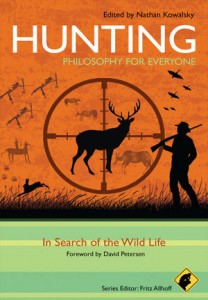
HUNTING: In Search of the Wild Life

The following comes from the Mindful Carnivore Blog. I haven't gotten the book yet, but the chapter by former Orion board member Val Geist is very well done.

Hunting philosophy for (and by) almost everyone

A philosopher I am not.
Not in the academic sense, at least. My formal education in the subject consists of a single undergraduate class—“Reason and Argument”—which left me impressed by the contortions through which the human animal is willing to put its gray matter.
So, some fifteen months ago, when I saw a “call for abstracts” for a new anthology of philosophical essays on hunting, I had reason to doubt my suitability as a contributor. The editor welcomed abstracts from philosophy, of course, and also from a number of other disciplines—such as anthropology, political theory, and theology—in which I was equally unqualified.
Yet there was this one little phrase. They also welcomed abstracts from “thoughtful hunters.”
After a few helpful email exchanges with the editor, Nathan Kowalsky of the University of Alberta, I said, “What the heck. Why not?” and shot from the hip, firing off a 250-word description of the 4,500-word essay I would write if he and his colleagues wanted me to.
A month later, I got word that they did.
Hello. Time to step up to the plate and deliver “Hunting Like a Vegetarian: Same Ethics, Different Flavors.”
Jump a year ahead and here we are: the book, Hunting: In Search of the Wild Life, has just been released, as part of Wiley-Blackwell’s series Philosophy for Everyone.
Read More

Monday, February 15, 2010

Quality Deer Management and the hunt

Cross-posted from the Grousers hunting blog.

I am currently working my way through Marc Boglioli's A Matter of Life and Death: Hunting in Contemporary Vermont, and I know that Eric has already read the book.

Boglioli has some interesting things to say about "Quality Deer Management," or QDM. The following paragraph caught my eye in light of a comment Eric has made on this blog recently about things that "take the hunt out of hunting," e.g., hunting gadgets, or high-fence. Does QDM fall into this category of potential threats to hunting's future?

Boglioli writes:
"While QDM may be an unqualified success for deer management in Vermont, it could well alter local meanings of hunting because of its emphasis on 'the trophy.' Most hunters, while certainly not opposed to the idea of bagging a 'Rackasaurus' on opening day, are thrilled to bring home any deer at all. If it happens to be unusually large, or has a trophy rack, so much the better. But QDM is a different philosophy. It focuses on the size of the deer and/or its rack as a way of determining the value of a hunting experience. This thought first crossed my mind when I initially learned about QDM in 2002 r 2003, and it was emphasized again in a conversation with a Vermont game warden in 2004, who said, 'The cultural perception of hunting has gone from process to product. . . . They're taking the hunt out of hunting.' A man at a local deer camp shared similar sentiments and pointed out (even though he agreed that it might be good for growing bigger deer) that QDM was a completely different approach from what he referred to as the Vermont 'family' hunting tradition, which is not oriented around a quest for trophy bucks but rather around the love of fresh venison, the enjoyment of family and friends, and the chance to spend some time in the woods rather than at work. Considering how many times I have heard hunters say 'You can't eat the horns,' I think this guy had a point." (p. 29)
Well, what do you think? Does QDM, Earn-a-Buck programs, and the like "take the hunt out of hunting"? Do we risk altering the "family hunting tradition" if we change the focus of hunting from process to product? Is this the end of hunting as we know it?